Category: Power, Systems & Colonial Structures
A vote is not a victory.
A declaration is not a check.
Today, April 8, 2026, the United Nations General Assembly officially declared the transatlantic slave trade the "gravest crime against humanity."
The room applauded.
The delegates shook hands.
The microphones captured the sound of self-congratulation echoing through the halls of global power.
But for those of us living in the spirit of the 1804 Renaissance, the sound was hollow.
It sounded like a performance.
It sounded like a stage play where the actors have mastered the lines but have no intention of changing the plot.
To recognize a crime 200 years after the fact, while clutching the stolen goods behind your back, is not justice.
It is theater.
The 1804 Lens
The UN is late.
They are two centuries behind the curriculum established by Jean-Jacques Dessalines and the people of Haiti.
In 1804, we didn't wait for a resolution to be passed in a distant hall to know our worth.
We didn't wait for a "Yes" vote from our oppressors to define our humanity.
Haiti declared slavery a crime by ending it: violently, decisively, and permanently.
The 1804 lens tells us that recognition from the system that birthed the crime is redundant.
We knew it was the gravest crime when we were in the fields.
We knew it was the gravest crime when our families were fractured for profit.
We knew it was the gravest crime when our names were erased to make room for ledger entries.
Now, in 2026, the global "powers that be" are finally catching up to a truth that was paid for in blood centuries ago.
But here is the catch.
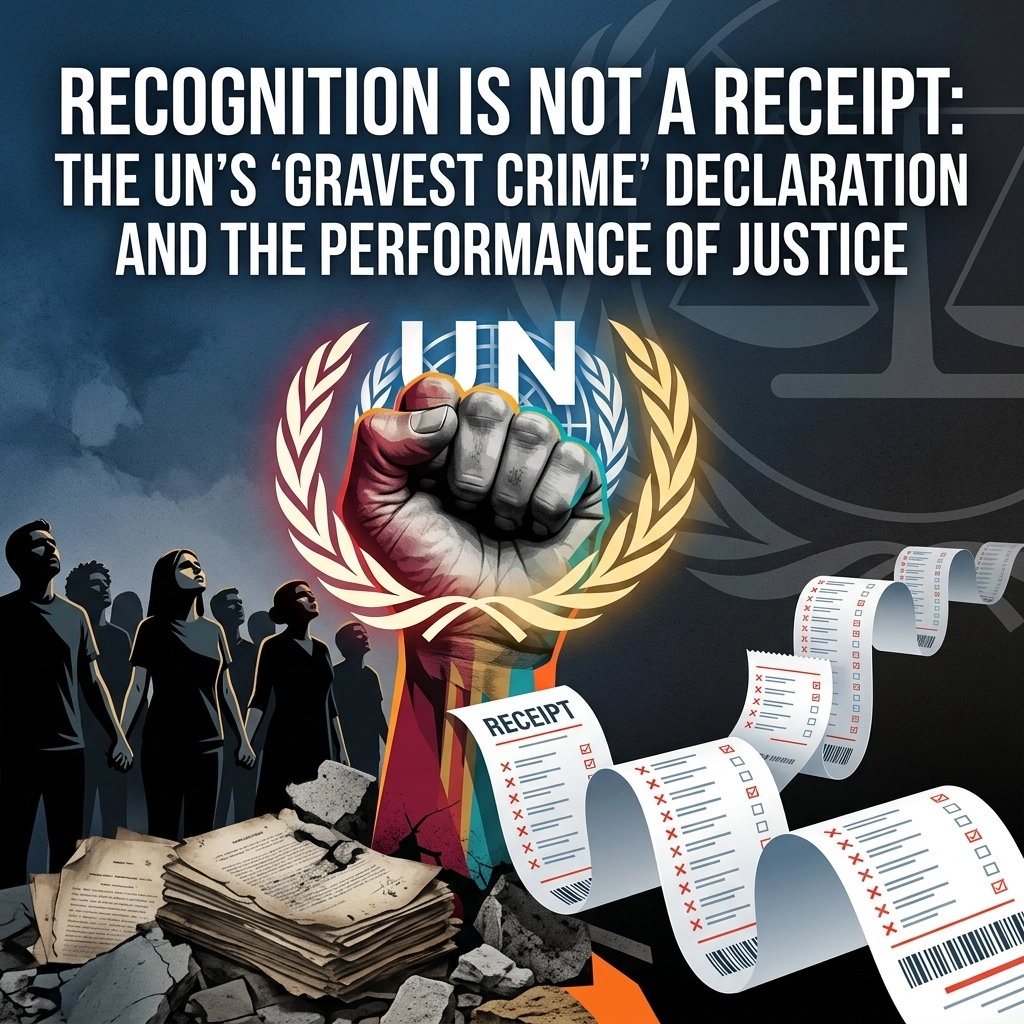
While they are busy calling it a crime, the very nations that built their skyscrapers and central banks on that crime: the United States, the United Kingdom, Spain: are either voting "No" or abstaining on the issue of reparations.
They are willing to offer the label.
They are unwilling to offer the receipt.

The New Colonialism
This is the birth of what we must call "The New Colonialism."
It is the practice of sanctifying the past while maintaining the theft of the present.
It is an attempt to normalize the status quo by offering a symbolic apology that costs exactly zero dollars.
They want to offer you the identity of "victim" because victims are manageable.
Victims wait for help.
Victims look for validation.
Victims settle for a holiday and a commemorative plaque.
But the "spoils" of the crime remain in the vaults of the West.
The wealth generated by the "gravest crime against humanity" continues to compound in interest, funding the education, infrastructure, and healthcare of the very nations that now claim to be "deeply saddened" by how that wealth was acquired.
To call something a crime without demanding restitution is to admit that the crime was successful.
It is to say, "We did something terrible to you, and we’ve decided to keep the profit as a souvenir of our growth."
This is the performance of justice designed to keep the current global power systems intact.
It is a psychological sedative.
Decolonization of the Mind
If we are to move forward, we must engage in the Decolonization of the Mind.
This process requires us to stop waiting for their "Yes" vote to validate our historical reality.
Why do we need the UN to tell us what we already know?
Why do we look for the signature of the thief on the document that describes the theft?
The internal landscape of the formerly colonized is often a fractured one, still seeking the approval of the parent-system that abused it.
We must stop being the children in the room, waiting for the adult-nations to admit they were wrong before we allow ourselves to be right.
The courage to define ourselves is the only courage that matters.
The courage to reject their timelines.
The courage to ignore their empty declarations.
In his book Alike Regardless: This Is Where It Began, Yvener Duroseau explores the necessity of understanding our shared origins to dismantle these systemic traps.
He writes: "The system does not fail; it functions exactly as it was designed to function. To expect it to provide justice is to misunderstand its architecture."
The architecture of the UN is built on the preservation of the current order.
It is not built to dismantle the foundations of Western wealth.
If they truly believed it was the "gravest crime," the resolution would have been followed by a transfer of assets.
It would have been followed by the cancellation of debts that were used to keep "decolonized" nations in a state of perpetual poverty.
It would have been followed by a "Yes" vote on the return of stolen cultural artifacts and the payment of centuries of back-wages.
Anything less is just a word.

Alike Regardless
We move forward by recognizing that we are Alike Regardless of the definitions they try to trap us in.
We are not just the descendants of a "gravest crime."
We are the architects of a new world.
The 1804 spirit is not about begging for a seat at a table that was built with our timber.
It is about building a new table.
It is about shifting the focus from "their recognition" to "our realization."
We must move without being trapped by their definitions of "progress" or "justice."
Justice is not a declaration.
Justice is the restoration of equilibrium.
You cannot have equilibrium when one side holds the capital and the other side holds the apology.
The Quiet Urgency of Now
The UN vote should serve as a reminder of how little the world has changed.
The resistance of the US, UK, and Spain is not surprising; it is consistent.
They fear legal accountability because legal accountability has a price tag.
They prefer the language of "reconciliation" over the language of "restitution."
They prefer "dialogue" over "distribution."
As we reflect on this April 8th resolution, let us not be distracted by the bright lights of the General Assembly.
Let us look at the voting board.
Let us see who refused to commit to the actual work of repair.
Then, let us return to the work of the mind.
The work of healing the internal fractures that make us believe we need their permission to be whole.
The work of building systems that do not rely on the crumbs of colonial guilt.
Recognition is cheap.
Justice is expensive.
And until the check is signed, we are still just watching a play.
We don't need their "Yes" to know we are free.
We already have the 1804 receipt.
To dive deeper into the themes of history, narrative power, and the internal journey of liberation, pick up a copy of Alike Regardless: This Is Where It Began by Yvener Duroseau.