Category: Decolonization of the Mind
Overview
This post examines the invisible psychological structures that shape our self-perception and value systems. By identifying the lingering fingerprints of colonial mentality, we can begin the radical work of reclaiming a sense of worth grounded in truth, history, and the revolutionary spirit of mental liberation.
Have you ever felt like a guest in your own skin?
Have you ever looked in the mirror and judged your features against a standard you didn’t create?
Have you ever walked into a room and lowered your voice because your natural rhythm felt "too much" for the space?
This is not a personal flaw.
This is the ghost of a dead empire sitting in your living room.
We live in a world where the chains have been moved from the ankles to the mind.
We call this colonial mentality.
It is the internalized belief that the culture, logic, and aesthetics of the colonizer are inherently superior to your own.
It is a slow-acting poison that makes you see your own people through the eyes of the person who conquered them.
But poisons have antidotes.
Decolonizing your mind is not just a catchphrase; it is a clinical extraction of lies.
It is the process of seeing the programming, refusing the script, and choosing your own worth on your own terms.
The Historical Shadow
Before we can heal, we must understand the depth of the wound.
Consider the Haitian Revolution.
In 1804, Haiti didn’t just break physical chains; it broke the logic of the entire world.
The Haitian Revolution facts are often buried because they are dangerous.
The idea that enslaved people could defeat the three greatest empires of the day: France, Britain, and Spain: was a threat to the global power system.
To neutralize that threat, the system didn't just use guns; it used narratives.
It turned Haiti into a "cautionary tale" rather than a beacon.
It demanded a massive "independence debt" to pay for the "lost property" of French slaveholders.
This systemic strangulation was designed to make the liberated feel like they were failing.
It was designed to make us believe that freedom is a burden we aren't equipped to carry.
We see this same pattern in our personal lives today.
We are told we are "developing."
We are told we are "third world."
We are told our traditions are "superstitions" while Western myths are called "classics."

Step 1: See the Water
You cannot change what you cannot name.
The first step in decolonizing your mind is awareness.
Notice the automatic superiority you grant to Western institutions.
Do you trust a doctor, a teacher, or an author more simply because they have a certain accent or a degree from a specific part of the world?
Do you feel a twinge of shame when your parents speak their native tongue in public?
This shame is not yours. It was planted.
As Ngũgĩ wa Thiong’o wrote in Decolonising the Mind, "The bullet was the means of the physical subjugation. Language was the means of the spiritual subjugation."
How to reclaim your worth:
Spend ten minutes writing down three moments where you felt "less than" because of your culture or race.
Ask yourself: Who taught me this?
Was I born thinking my hair was unprofessional?
Was I born thinking my history was a tragedy?
Naming the source of the lie is the first act of rebellion.
Step 2: Fact-Check the Lies
Colonialism survives on the myth of the "civilizing mission."
It tells us that they brought order to our chaos.
It tells us that they brought light to our darkness.
But look at the looted art in European museums.
Look at the stolen gold and the extracted labor.
They didn't bring civilization; they brought a vacuum.
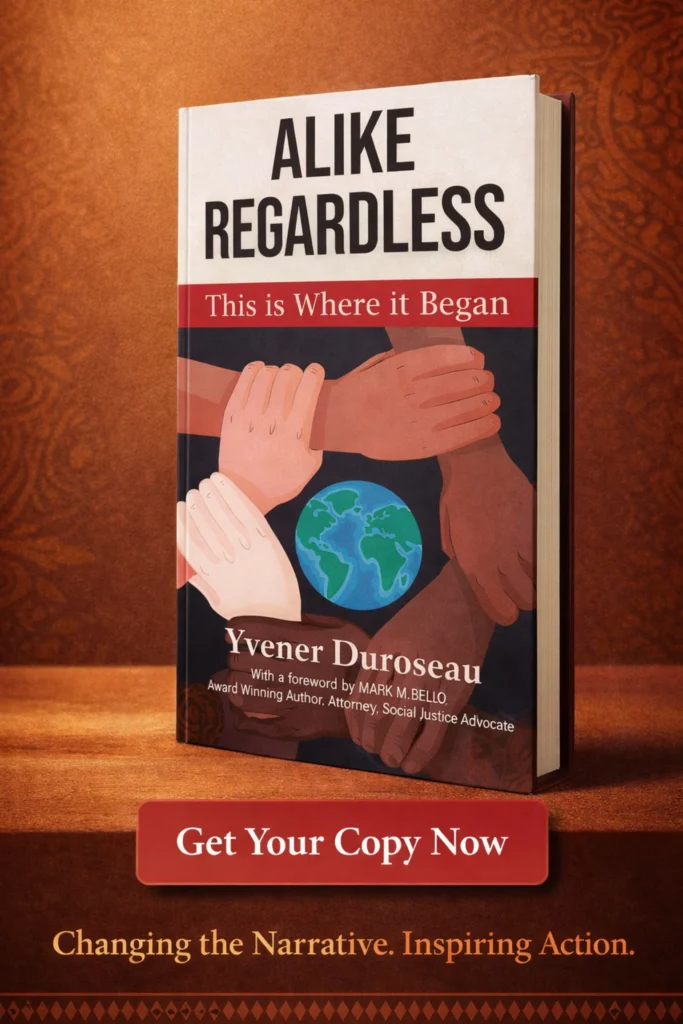
In my book, Alike Regardless: This Is Where It Began, I explore the ways we are conditioned to ignore our shared humanity in favor of these manufactured hierarchies.
We are taught to believe our value is tied to how well we can mimic our oppressors.
We are taught to believe that "professionalism" is just another word for "whiteness."
How to reclaim your worth:
Pick one belief you hold about your community being "backward" or "disorganized."
Find the historical root.
Did your people lack organization, or were their systems of governance systematically dismantled?
Replace the lie with a truth.
Not to process pain, but to endure it.
Not to seek approval, but to find dignity.

Step 3: Re-Root in the Self
You cannot decolonize a self you do not know.
Many of us are experts in the history of our colonizers but strangers to our own ancestors.
We know the names of the kings who conquered us, but not the names of the grandmothers who kept our languages alive in whispers.
Self-knowledge is the ultimate form of resistance.
It is about building a foundation that does not require a Western permit.
In Alike Regardless: This Is Where It Began, I argue that we must return to the source to understand our true identity.
We must look past the fractured narratives and reclaim the memory of who we were before the world told us who we should be.
How to reclaim your worth:
Read a book by an author from your own culture.
Listen to the music your elders loved.
Learn five words in your ancestral language that don't have a direct translation in English.
These words are the containers of your soul.

Step 4: Rewire Your Daily Habits
The mind is a muscle that has been trained to bow.
You must retrain it to stand.
This happens in the small, quiet moments of your day.
It happens when you choose not to laugh at a joke that belittles your people.
It happens when you stop using words like "civilized" or "primitive."
It happens when you curate your social media feed to reflect the beauty of the Global South.
The media diet we consume is often a colonial one.
If you only see your people as victims of famine or war, you will internalize a sense of helplessness.
If you only see your culture as a costume, you will treat your identity as a performance.
How to reclaim your worth:
Audit your inputs.
Follow creators who challenge the status quo.
Stop seeking validation from spaces that were never built for you.
The courage to silence the noise.
The courage to trust your own eyes.
The courage to define success on your own terms.
Step 5: Live Your Reclaimed Worth in Community
Decolonization is not a solo sport.
It is a collective awakening.
Colonialism works by isolating us.
It makes us compete for the "token" spot at the table.
It makes us fear that if another person from our community succeeds, there is less for us.
This is the "scarcity mindset" of the plantation.
To reclaim your worth, you must practice solidarity.
You must see your liberation as tied to the liberation of others.
How to reclaim your worth:
Find a community where your full self is welcome.
Support businesses owned by your people.
Mentor someone who is still struggling with the shame you once felt.
We are not just surviving a system; we are building a new one.

The Quiet Urgency of Now
Decolonizing your mind is the hardest work you will ever do.
It is a surgery performed without anesthesia.
But it is the only way to be truly free.
The system wants you to be a well-adjusted cog in a machine that doesn't love you.
I want you to be a person who knows they are enough.
I want you to be a person who understands that your worth was settled the moment you drew your first breath.
The Haitian Revolution wasn't just about land.
It was about the right to be human.
You are the descendant of that right.
You are the heir to that revolution.
It is time to act like it.
It is time to think like it.
It is time to be it.
The work begins within.
If you’re ready to dive deeper into these themes of identity and human connection, pick up a copy of my book, Alike Regardless: This Is Where It Began.
Join the conversation on LinkedIn and explore more reflections on my blog.