Category: Decolonization of the Mind
Overview
This essay explores the profound impact of decolonization psychology on the human psyche and the reconstruction of selfhood. By examining how inherited colonial frameworks distort our self-perception, we uncover the path toward authentic liberation and the mental reclamation necessary for true human unity. It challenges the reader to look inward and dismantle the structures that have long defined who they think they are.
Who are you when the mirrors provided by society are intentionally cracked?
Most of us move through the world wearing an identity we did not weave ourselves.
We inherit languages that do not speak our truths.
We adopt philosophies that were designed to exclude us.
We inhabit a psychology that was built to categorize, minimize, and ultimately, to govern our internal landscapes.
Decolonization psychology is not merely an academic shift; it is a visceral reclamation of the self.
It is the realization that your "personality" might actually be a set of survival mechanisms developed within a system that never intended for you to thrive.
To understand your identity through the lens of decolonization is to admit that your mind has been occupied territory.
The Architecture of the Occupied Mind
For centuries, the Western world has been the primary architect of what we call "normal."
Psychology, as a formal discipline, was birthed in a specific European context.
It focused on the individual, the rational, and the observable.
But for those whose histories are rooted in the collective, the spiritual, and the ancestral, this framework feels like a cage.
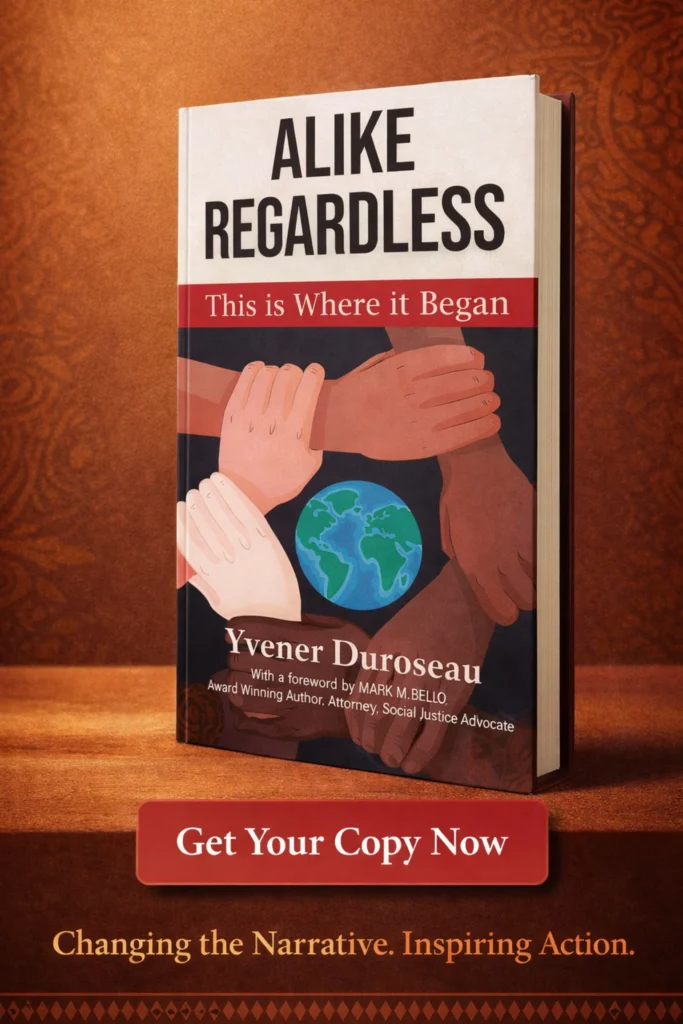
In my book, Alike Regardless: This Is Where It Began, I explore the intersections of our shared humanity and the artificial barriers we have erected between us.
These barriers are not just physical borders.
They are psychological blueprints.
When we talk about the "Decolonization of the Mind," we are talking about the hardest work a human being can do.
It is the work of auditing your own thoughts.
It is the work of asking: "Is this my voice, or is this the voice of the person who conquered my ancestors?"

The Haitian Mirror: A Lesson in Radical Identity
Haitian history provides perhaps the most potent example of physical decolonization the world has ever seen.
In 1804, a nation of enslaved people did the unthinkable: they defeated the greatest empire of the time to claim their sovereignty.
They broke the chains.
They burned the plantations.
They sanctified the soil with the blood of their liberation.
Yet, as any student of history knows, the end of physical slavery is not the end of the colonial project.
The chains moved from the ankles to the psyche.
The world responded to Haitian independence with isolation, debt, and a narrative of "poverty" that ignored the wealth of the Haitian spirit.
If we view ourselves through the eyes of the colonizer, we see a fractured history.
If we view ourselves through decolonization psychology, we see a legacy of unparalleled resilience.
Identity is not what happened to you; it is the narrative you choose to honor.
The Myth of the Universal Self
Conventional psychology often treats the human experience as a universal constant.
It assumes that trauma, joy, and identity look the same in a boardroom in Manhattan as they do in a village in the Artibonite Valley.
This is a fallacy.
The trauma of a person whose culture was systematically erased cannot be "cured" by a psychology that refuses to acknowledge that erasure.
We have been taught to internalize our failures as personal defects.
We feel inadequate because we do not meet the standards of a "civilization" that was built on our exclusion.
Decolonization psychology forces us to shift the blame from the individual to the system.
It teaches us that our anxiety is often a sane reaction to an insane environment.
It teaches us that our "identity crisis" is actually an identity awakening.

The Courage to Remember
The process of decolonizing the mind requires a specific kind of intellectual bravery.
The courage to look at your faith and ask where the dogma ends and the spirit begins.
The courage to look at your language and ask what thoughts you are unable to think because the words were taken from you.
The courage to look at your heritage and refuse to feel shame for the "primitive" or the "unrefined."
In the words of Frantz Fanon in The Wretched of the Earth: "Imperialism leaves behind germs of rot which we must clinically detect and remove from our land but from our minds as well."
We must become our own clinicians.
We must perform the surgery on our own consciousness.
Not to process pain, but to endure it.
Not to adapt to the system, but to transcend it.
Beyond the Binary of Us and Them
One of the most dangerous legacies of colonial thought is the creation of the "other."
It functions by convincing us that our differences are fundamental gaps rather than superficial variations.
This is why I wrote Alike Regardless: This Is Where It Began.
I wanted to point toward the underlying truth that exists beneath the layers of colonial conditioning.
We are fractured, yes.
We are divided, certainly.
But the core of the human experience remains untouched by the scars of history.
Decolonization psychology allows us to strip away the "otherness" that was forced upon us.
When I decolonize my mind, I no longer see you as a threat to my identity.
I see you as a fellow traveler who may be carrying the same invisible luggage.

The Body and the Psyche: Where History Lives
We often speak of identity as an abstract concept.
But identity is visceral.
It lives in the nervous system.
It lives in the way your heart rate increases when you enter certain spaces.
It lives in the way you lower your voice to sound more "professional."
Colonialism normalized the suppression of the body’s wisdom.
It taught us to trust the intellect over the intuition.
Decolonizing your identity means returning to the body.
It means listening to the ancestral memory that vibrates in your bones.
It means refusing to allow your worth to be measured by your productivity in a system that views you as a tool.
A New Way of Seeing
As we look toward the future, the "Decolonization of the Mind" stands as the next great frontier of human evolution.
It is the necessary precursor to any lasting social change.
You cannot build a free society with a captive mind.
You cannot create unity with a fractured sense of self.
This shift in psychology will change how you view your identity because it removes the ceiling.
It tells you that you are not a "minority" in a white world.
It tells you that you are a majority in a global story of survival and creativity.
It tells you that your history did not begin with a boat, and it will not end with a paycheck.

The Final Word on Reclamation
We are living in an era of profound uncovering.
The old narratives are failing.
The structures are shaking.
And in the middle of this chaos, you have the opportunity to decide who you are.
Do not accept the definitions handed down by those who did not love you.
Do not sanctify the traditions that were designed to keep you small.
The work of decolonization is quiet, urgent, and deeply personal.
It happens in the silence between your thoughts.
It happens when you choose to honor your own reflection.
Reclaim your mind.
Reclaim your memory.
Reclaim your right to be whole.
To dive deeper into these reflections on human unity and the dismantling of these historical barriers, I invite you to read Alike Regardless: This Is Where It Began.
It is time we look at the world, and ourselves, with new eyes.
You can find more essays and resources on this journey of mental liberation at yvenerduroseau.com and browse my latest thoughts on the blog page.
The mind is the last colony.
It is time for its independence.