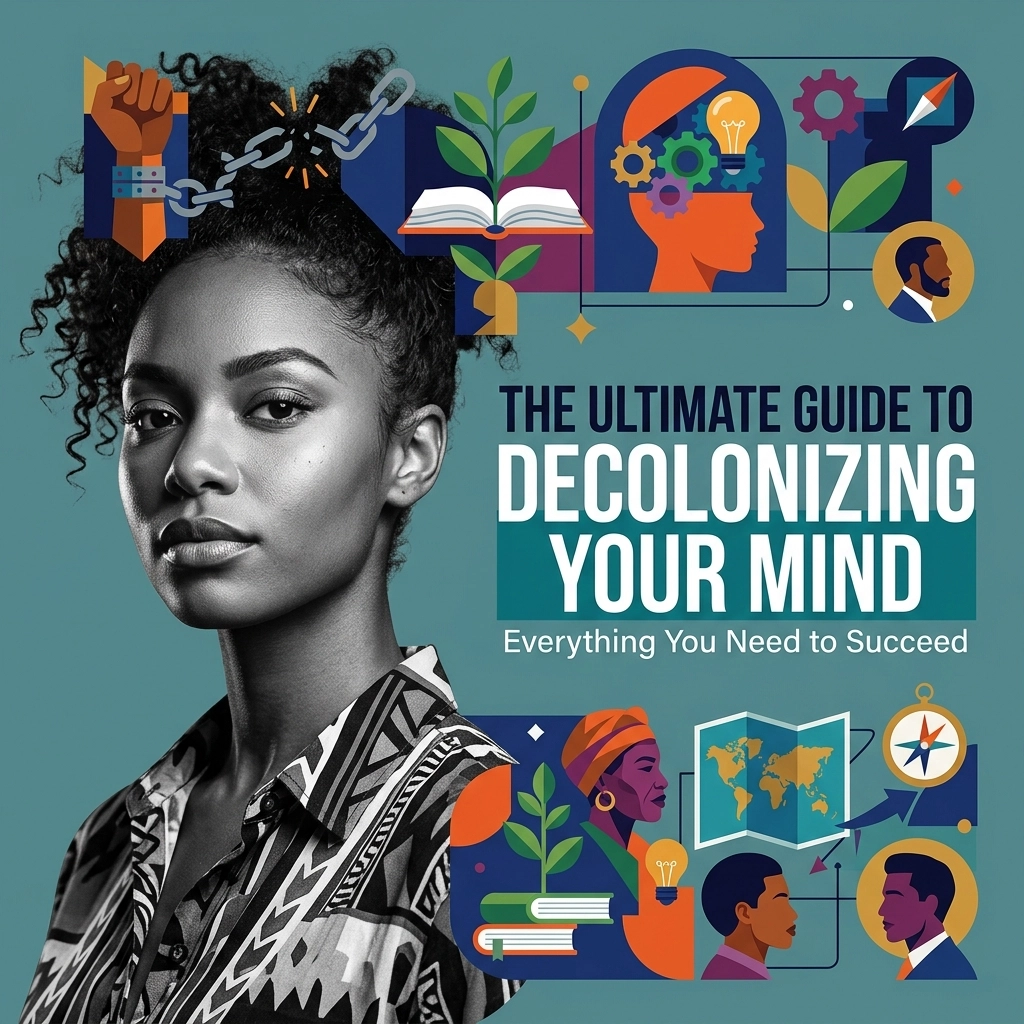
Category: Decolonization of the Mind
Overview
This guide explores the psychological architecture of colonial influence and provides a roadmap for reclaiming mental sovereignty. It examines the interplay between history, identity, and the internal narratives that dictate our sense of worth, offering a path toward genuine intellectual liberation.
Who owns the voice inside your head?
It is a question we rarely ask because we assume the voice is our own.
We assume our preferences, our fears, and our definitions of success are biological or accidental.
They are neither.
For most of us, the mind is a captured territory.
It is a space where historical traumas and imported hierarchies have built their homes, often without our consent.
To decolonize the mind is to conduct an audit of your own consciousness.
It is the process of evicted the "master" from the library of your soul.
The Ghost of 1804
We must begin with the weight of history.
In 1804, Haiti did the unthinkable.
An enslaved people broke their physical chains and declared themselves sovereign.
It was 1804: The Blueprint for Modern Freedom.
But as history has shown, a physical revolution is only the first step.
While the chains fell from the wrists, the blueprints of the plantation were often left behind in the psyche.
The colonizer left the land but stayed in the language.
He left the government but stayed in the pews.
He left the economy but stayed in the mirror.
We see this in the way we view our own history: as a series of tragedies rather than a sequence of triumphs.
We see it in the way we prioritize European logic over ancestral wisdom.
The struggle for the modern mind is a struggle to realize that the revolution of the 18th century remains unfinished as long as we view ourselves through the eyes of our former oppressors.

The Language of the Subconscious
Consider the way you speak.
Not just the words you choose, but the hierarchy you assign to them.
In the Haitian context, the tension between French and Kreyòl is not merely linguistic.
It is an exercise in power.
When we deem a language "uneducated" or "informal," we are not making a phonetic judgment.
We are internalizing a colonial decree.
This is why linguistic sovereignty matters.
To speak your own truth in your own tongue is an act of decolonization.
It is a refusal to perform for a ghost that no longer has the authority to grade your performance.
The same applies to our spiritual lives.
We have been taught to sanctify the symbols of the West while demonizing the rhythms of our ancestors.
We have been conditioned to believe that God only speaks the language of the conqueror.
This is a fractured way to live.
It creates a rift between the heart and the head.
It forces us to suppress our "Rhythm of Resilience" in favor of a sterile, imported piety.
The Architecture of the Internalized Self
In my book, Alike Regardless: This Is Where It Began, I explore the fundamental truth that we are more similar than the systems of power would have us believe.
Colonialism relies on the fabrication of difference.
It requires a "default" and a "deviant."
It requires us to look at our neighbor and see a threat rather than a mirror.
To decolonize is to dismantle these internal partitions.
The courage to look past the label.
The courage to unlearn the fear of the "other."
The courage to see the human spirit as something that cannot be categorized by the census of a dead empire.
We must recognize that internalized dominance and internalized oppression are two sides of the same coin.
One believes it is the sun, and the other believes it is the shadow.
Both are illusions.

Step 1: Trace the Sources
How do you begin the work?
You begin by naming the architect.
Take a moment to reflect on your definition of "professionalism."
Does it look like you, or does it look like someone who would have owned your ancestors?
Reflect on your definition of "beauty."
Does it celebrate the texture of your hair and the depth of your skin, or is it a filtered imitation of a Nordic ideal?
Trace these beliefs back to their origin.
If a belief makes you feel small, it did not come from your creator.
If a belief makes you feel superior to another human being based on race or class, it is a tool of the colony.
Identify the message.
Write it down.
Strip it of its power by exposing its source.
Step 2: Somatic Sovereignty
Decolonization is not just an intellectual exercise.
It is a physical one.
The body remembers what the mind tries to forget.
Trauma lives in the nervous system.
It manifests as hypervigilance, as a "quiet urgency" that never allows for rest.
We have been taught that productivity is our only worth.
This is a capitalist-colonial lie designed to keep the machine running.
Rest is resistance.
Joy is a revolutionary act.
To breathe deeply, without permission, is to reclaim the space that was once stolen.
We must ground ourselves in our bodies.
Feel your feet on the soil.
Understand that you are a part of a living system, not a cog in an extractive one.
The Lakou system offers a framework for this: a communal way of living that honors the land and the person as one.
Step 3: Center the Ancestral Narrative
The West does not have a monopoly on truth.
We must actively seek out the knowledge systems that were suppressed.
This is the core theme of my forthcoming work, Decolonization of the Mind.
It is about moving beyond criticism of the old and toward the construction of the new.
We are not just "not-colonial."
We are something original.
We are the heirs to a philosophy that predates the arrival of the ships.
As Ngũgĩ wa Thiong'o wrote in Decolonising the Mind: The Politics of Language in African Literature: "The bullet was the means of the physical subjugation. Language was the means of the spiritual subjugation."
To reclaim the language is to reclaim the spirit.

The Practice of Unlearning
This is a lifelong process.
There is no "graduation" from a decolonized mind.
There is only the daily choice to be conscious.
The choice to question the news.
The choice to diversify your bookshelf.
The choice to build bridges across the diaspora.
We are rebuilding the Haitian Social Contract within ourselves first.
We cannot build a free society with enslaved minds.
We cannot demand respect from the world if we harbor self-contempt in our hearts.
A Powerful Conclusion
The mind is the final frontier of liberation.
The walls are high, but they are made of paper.
They are held together by the glue of our own compliance.
When we stop believing in the myths of our own inferiority, the walls crumble.
When we start believing in the inherent dignity of the human soul, the sun rises.
You are not a problem to be solved.
You are not a history to be ashamed of.
You are the architect of a new renaissance.
Start the work today.
Question the voice.
Reclaim the silence.
Be sovereign.
To support this journey of self-discovery and unity, I invite you to read my book, Alike Regardless: This Is Where It Began.
It is a roadmap for those ready to see beyond the fractured lens of the present.
The journey toward a decolonized mind is the most difficult trek you will ever take.
It is also the only one that leads home.