Category: Decolonization of the Mind
Overview:
This essay explores the profound psychological journey of reclaiming one's intellectual and spiritual autonomy from internalized colonial structures. By examining the intersections of history, self-awareness, and cultural narrative, we outline a five-step framework for decolonizing the psyche and rediscovering the inherent unity of the human experience. Readers will gain insight into how to dismantle inherited myths and forge a path toward true mental liberation.
Have you ever considered that your most intimate thoughts might not actually be your own?
We are born into a landscape of language, tradition, and belief that was mapped out long before we took our first breath.
We inherit a script.
We perform a role.
We navigate a world that has already decided what is valuable and what is disposable.
To decolonize the mind is to realize that the territory of your consciousness has been occupied.
It is the realization that the "I" you refer to is often a collection of echoes from a history designed to keep you small.
Intellectual liberation is not a comfortable process.
It is a surgical one.
It requires us to identify the sutures of colonial thought and begin the slow, deliberate work of pulling them out.
Step 1: Cultivate a Radical Self-Awareness
The first step is the investigation.
You must become a stranger to yourself so that you can see yourself clearly.
We often mistake our conditioning for our character.
We think the way we view power, success, and worth is simply "the way things are."
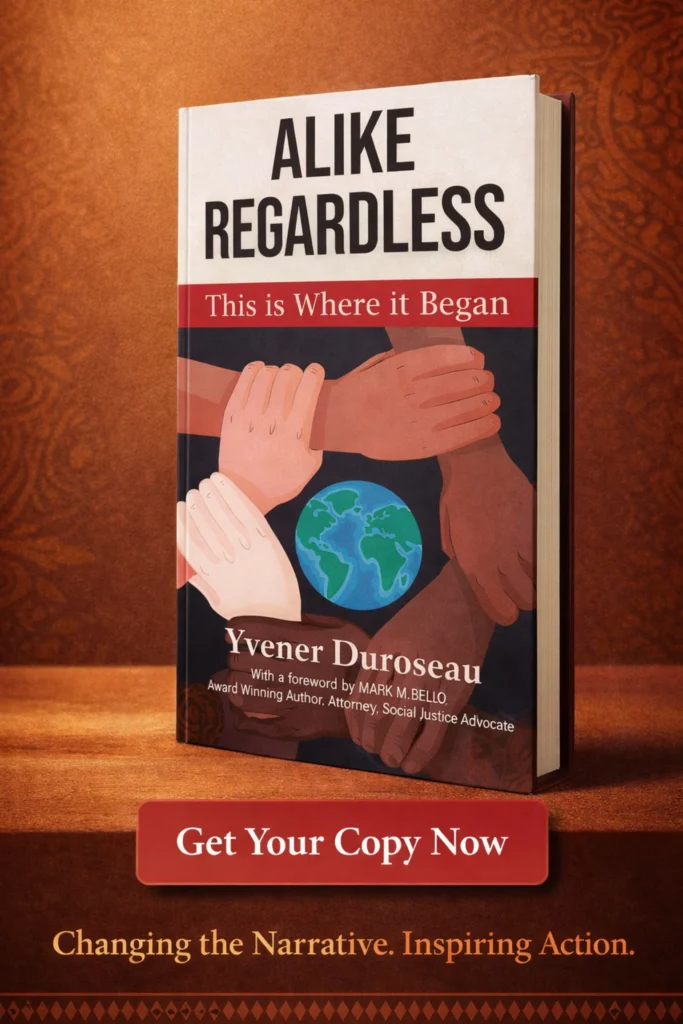
In my exploration of these themes, particularly through the lens of our shared human origins in Alike Regardless: This Is Where It Began, I highlight that our perceived differences are often layers of social architecture rather than biological reality.
To decolonize is to ask: Who taught me to value this?
Who taught me to fear that?
Whose gaze am I trying to satisfy when I look in the mirror?
You must develop the courage to sit in the silence of your own mind and wait for the voices that aren't yours to speak.
They will speak in the language of inadequacy.
They will speak in the language of hierarchy.
Once you hear them, they lose their power to command you.
Step 2: Identify and Destabilize the "Big Lie"
Every colonial system is built upon a foundation of myths.
The primary myth is that of the hierarchy of humanity.
This is the "Big Lie" that suggests some cultures are the "standard" and others are merely "deviations."
In Haitian history, we see the most visceral rejection of this lie.
The 1804 revolution was not just a physical battle; it was an ontological one.
It was a declaration that the African soul was not a commodity to be traded, but a sovereign entity to be respected.
Yet, even when the chains are broken in the physical world, they often remain intact in the psyche.
We continue to sanctify Western knowledge while dismissing ancestral wisdom as "superstition."
We continue to use the colonizer’s metrics to measure our own intelligence.
As Ngũgĩ wa Thiong’o famously wrote in Decolonising the Mind: The Politics of Language in African Literature: "The bullet was the means of the physical subjugation. Language was the means of the spiritual subjugation."
To reclaim agency, you must identify these linguistic and cultural traps.
You must stop asking for permission to exist from the very systems that benefit from your erasure.

Step 3: Reorient Your Relationship with the Body and the Land
Colonization functions by alienating the individual from the physical.
It teaches us that the mind is superior to the body.
It teaches us that the land is an object to be extracted from, rather than a community to be a part of.
This fracturing is the root of our modern malaise.
We treat our bodies like machines and the earth like a warehouse.
Decolonization requires a return to the visceral.
It requires us to listen to the somatic intelligence that the colonial education system taught us to ignore.
Not to process pain, but to endure it.
Not to feel the earth, but to own it.
We must unlearn the habit of viewing ourselves as separate from the natural world.
We must recognize that our agency is tied to our interconnectedness.
When we reclaim our bodies, we reclaim our history.
When we reclaim our history, we reclaim our future.
Step 4: Center the Silenced and Diversify Your Intellectual Diet
The "universal" canon is often just the provincial history of the West.
If your library only contains the thoughts of those who look like the conqueror, your mind will eventually mirror the conqueror’s limitations.
Intellectual liberation demands a radical expansion of your sources.
Seek the poets who were silenced.
Read the historians who were labeled "radical."
Listen to the elders whose stories were never written down.
This is not just about representation; it is about cognitive diversity.
It is about understanding that there are multiple ways to be human.
There are multiple ways to solve a problem.
There are multiple ways to perceive time.
By centering marginalized voices, you aren't just helping them; you are freeing yourself from the narrow corridor of colonial thought.
You are allowing yourself to breathe in a larger world.

Step 5: Commit to Continuous Liberation
Decolonization is not a destination.
It is not a certificate you hang on the wall.
It is a daily practice of vigilance.
The systems we inhabit are designed to pull us back into the familiar grooves of hierarchy and competition.
They offer us the "comfort" of the script.
To resist is to choose the discomfort of the unknown.
The courage to question.
The courage to evolve.
The courage to acknowledge that we are all, at our core, interconnected.
In my forthcoming work on the Decolonization of the Mind, I delve deeper into how these mental structures affect our ability to lead and innovate in the 21st century.
True leadership requires a mind that is no longer a tenant in someone else’s house.
It requires a mind that is sovereign.
The Unified Self
We often speak of decolonization as a process of separation.
But in reality, it is a process of reunification.
It is about bringing the fractured pieces of the human story back together.
It is about moving beyond the "us versus them" binary that the colonial project relied upon.
When we strip away the layers of conditioning, what remains?
A fundamental human agency that is common to us all.
A capacity for creation that does not require the destruction of others.
A sense of unity that is the central theme of Alike Regardless: This Is Where It Began.
We must remember that the walls in our minds were built to protect a system, not to protect us.
Tear them down.
Reclaim your territory.
Walk in your own light.
The world is waiting for the person you were meant to be before you were told who you were supposed to be.
Intellectual liberation is the only true freedom.
It begins with a single question.
It ends with a reclaimed life.
Deepen your journey into the origins of our shared humanity.
Grab your copy of Alike Regardless: This Is Where It Began and discover the truth behind our perceived divisions.