Category: Decolonization of the Mind
Overview: This post explores the fundamental concepts of mental decolonization, examining how colonial narratives still shape our psyche today. We dive into the historical legacy of the Haitian Revolution and provide a philosophical framework for reclaiming your intellectual and cultural autonomy.
Who told you that your history began in chains?
Have you ever stopped to wonder if the voice inside your head actually belongs to you?
We live in a world of borrowed thoughts.
We inhabit a reality constructed by architects who never intended for us to be the masters of the house.
To speak of decolonization is often to speak of land, of borders, and of flags.
We talk about the physical removal of the occupier.
But the most resilient colony is the one that exists between your ears.
The mind is a vast, fertile territory.
If you do not plant your own seeds, someone else will plant theirs.
The Unfinished Revolution
In 1804, the world shifted on its axis.
The Haitian Revolution was not merely a military victory; it was a cosmic disruption.
It was the moment when the "property" stood up and declared itself "human."
These haitian revolution facts are often buried under layers of Western anxiety because they represent the ultimate failure of the colonial logic.
The revolutionaries broke the physical chains of the most powerful empire of the time.
They burned the plantations.
They reclaimed the soil.
But as the smoke cleared, a deeper question remained: how do you remove the overseer from your dreams?
Physical liberation is a moment in time; mental liberation is a lifetime of labor.
We inherited a world where "civilization" was defined by those who sought to erase us.
We inherited a language that was designed to categorize us as "other."

Understanding the Colonial Mentality
The colonial mentality is a sophisticated ghost.
It does not scream; it whispers.
It whispers that foreign is better than local.
It whispers that your natural hair is "unprofessional."
It whispers that your ancestral spirituality is "superstition," while the religion of the colonizer is "faith."
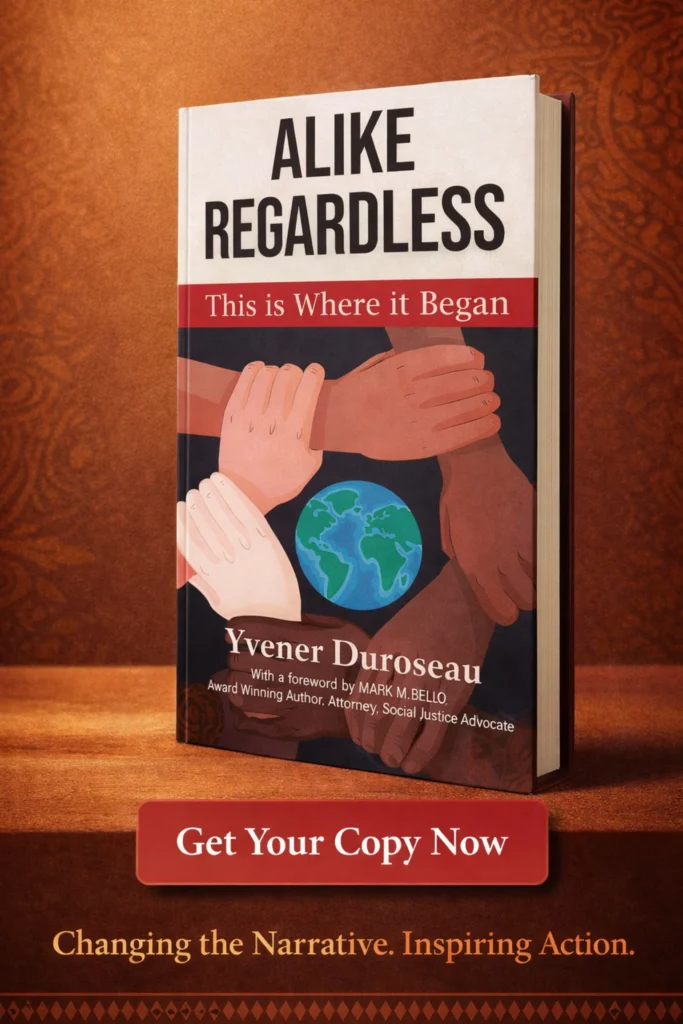
In my book, Alike Regardless: This Is Where It Began, I examine the fractures in our human story: the moments where we began to see ourselves through the lens of separation rather than unity.
We have been conditioned to sanctify the very systems that were built to exclude us.
This is the "fractured" psyche.
It is the internal conflict of loving the hand that holds the whip because that hand also holds the textbook.
To decolonize the mind is to recognize that your current preferences might actually be programmed responses.
The Power of Language and Narrative
Language is not just a tool for communication.
Language is a carrier of culture.
As Ngũgĩ wa Thiong'o famously argued in Decolonising the Mind, language is the "collective memory bank of a people's experience in history."
When you are forced to think in the language of an oppressor, you are forced to see the world through their metaphors.
You begin to measure your progress by their metrics.
You begin to define "success" by how closely you can mimic their lifestyle.
This is a normalized form of self-erasure.
It is a quiet suicide of the soul.
We must have the courage to interrogate the words we use.
The courage to reclaim the narratives we’ve been told to forget.

A Beginner’s Guide to the Internal Landscape
How do you begin to master mental liberation?
It starts with the "quiet urgency" of observation.
1. Identify the Internalized Overseer.
Notice when you feel shame for things that are natural to your heritage.
Is that shame yours, or was it given to you?
2. Question the "Global" Standard.
When we say something is "world-class," whose world are we talking about?
When we say a system is "rational," whose logic are we employing?
3. Reconnect with the Ancestral Memory.
The decolonization of the mind requires a return to the roots.
Not to live in the past, but to draw nutrients from it.
Haiti’s revolutionary legacy is a blueprint for the impossible.
It reminds us that the systems governing us are not divine laws: they are human inventions.
4. Embrace Intellectual Bravery.
It is easy to follow the crowd.
It is difficult to stand alone with a truth that contradicts the status quo.
Mental liberation is not for the faint of heart.
The Modern Reflection
Today, colonization doesn't always wear a pith helmet.
It wears an algorithm.
It wears a corporate branding strategy.
It wears a global power system that dictates which lives matter and which art is "refined."
We see it in the debates over reparations and the struggle to return looted art to its rightful homes.
These are not just political arguments; they are psychological battlegrounds.
Returning a bronze statue to Benin is a physical act, but the mental act is recognizing that the statue never belonged in a London museum in the first place.
It is about breaking the spell of "the way things are."
Nothing is just "the way it is."
Everything is the way it was made.

The Courage to Be Free
The work of decolonization is often uncomfortable.
It forces us to look at the parts of ourselves we have carefully curated to fit in.
It forces us to admit that we have been complicit in our own mental imprisonment.
But there is a profound joy on the other side of that discomfort.
It is the joy of finally meeting yourself.
Not the version of you that was processed through an education system designed to create workers.
Not the version of you that was molded by a media landscape designed to create consumers.
But the version of you that existed before the world told you who you were supposed to be.
The courage to ask.
The courage to look.
The courage to be.
Final Thoughts on the Journey
This is not a destination you reach and then stop.
It is a continuous process of weeding the garden of your psyche.
You will find old beliefs tucked away in the corners of your mind, like dusty relics of a former occupation.
Do not be afraid to throw them out.
You are the sovereign of your own consciousness.
The journey toward mental liberation is the only journey truly worth taking.
It is the process of reclaiming your humanity from the jaws of a system that tried to turn you into a category.
Read, reflect, and begin the work of unlearning.
For those looking to understand the roots of our shared human identity and how we might move toward a more unified future, I invite you to explore Alike Regardless: This Is Where It Began.
The chains are gone.
Now, it is time to wake up.
Purchase your copy of Yvener Duroseau's book here:
Alike Regardless: This Is Where It Began