Category: Power, Systems & Colonial Structures
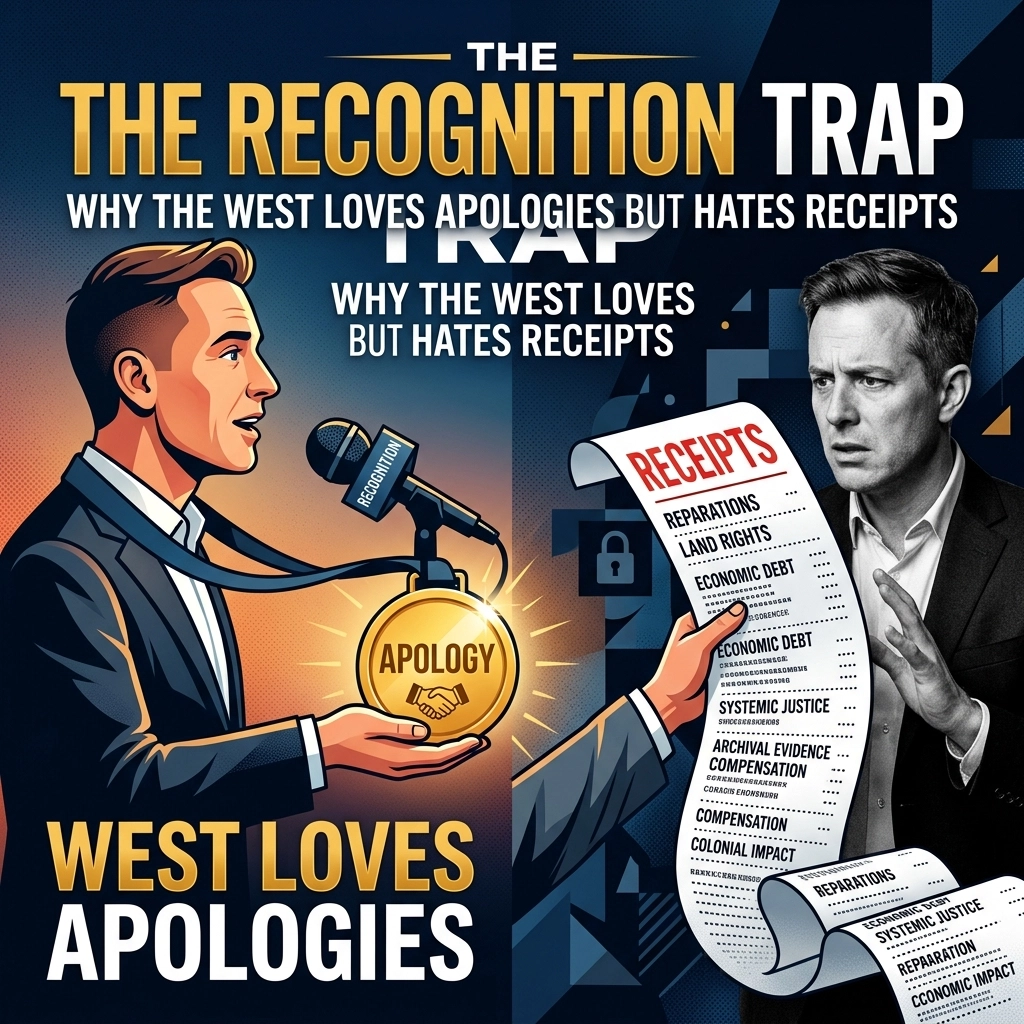
An apology costs nothing.
A receipt costs everything.
In the current global theater, we are witnessing a peculiar performance. Western nations are finally finding the vocabulary to describe their history. They are using words like "regret," "atrocity," and even "crime against humanity." They are bowing their heads. They are shedding curated tears.
But when the African Union or CARICOM brings the ledger to the table, the room goes cold.
The West is currently trapped in a loop of performative remorse. They love the optics of recognition, but they have a visceral, systemic allergy to the receipt. This is the "Recognition Trap": a sophisticated mechanism of managed memory designed to keep the status quo intact while appearing to change.
We see it in the news every day. A European monarch expresses "deep regret" for the horrors of the slave trade. A prime minister acknowledges the "dark chapters" of colonial history. Yet, moments later, those same governments vote "No" on reparations. They offer a hand in friendship while keeping the other hand firmly on the stolen purse.

The 1804 Reality vs. The Recognition Weapon
To understand this trap, we have to look back at the 1804 Renaissance spirit.
In 1804, Haiti did something unforgivable. It didn't wait for permission to exist. It didn't petition for a seat at the table. It broke the table and built its own.
Haiti forced recognition through the sheer force of the will and the blade. But the colonial world quickly realized that if they couldn't defeat the 1804 reality on the battlefield, they could weaponize "recognition" itself.
By 1825, France offered a deal that would set the blueprint for modern neo-colonialism. They offered "recognition" of Haitian independence: for a price. That price was 150 million francs. Haiti was forced to pay for the "property" it had liberated: itself.
This was the birth of the Recognition Trap.
The West said: "We will acknowledge you exist, but only if you pay us for the privilege."
Today, the script has flipped, but the intent remains the same. Now, the West offers "recognition" of their crimes as a way to avoid paying the debt. They hope that by calling the slave trade a "crime," the victim will be satisfied with the label and forget about the invoice.
Managed Memory: The Architecture of the "Sorry"
Why is an apology so popular right now? Because an apology is an exercise in "Managed Memory."
Managed memory is the process of acknowledging a past horror only to quarantine it in the past. It is a way of saying, "That was then, this is now." It frames systemic theft as a historical accident rather than a foundation of modern wealth.
The West wants to sanctify their history without cleaning it.
They want the moral high ground of the penitent without the financial loss of the payer.

This is where Decolonization of the Mind becomes a survival tool. Without a decolonized perspective, we might actually believe that a plaque in a museum or a speech in a parliament constitutes justice. We might internalize the idea that "recognition" is the end goal.
It is not. Recognition is the floor. Justice is the ceiling.
The courage to admit is not the same as the courage to repair.
The courage to speak is not the same as the courage to pay.
The courage to remember is not the same as the courage to return.
The Stiff Arm of Reparations
The African Union and CARICOM are currently pushing for actual repair. They are moving beyond the symbolic and into the structural. They are asking for the return of artifacts, the cancellation of debts, and the direct investment of wealth back into the nations that were drained to build the "developed" world.
The response from the West is a masterclass in deflection.
They argue that "current generations shouldn't pay for the sins of their ancestors."
Yet, current generations continue to live in the houses built by those sins. They continue to spend the interest on the capital generated by those sins. They continue to benefit from the global trade systems designed by those sins.
They want the inheritance, but they reject the debt.
This is a fractured logic. You cannot claim the assets of history while disavowing the liabilities.
In Alike Regardless: This Is Where It Began, the exploration of human unity and historical narrative power reminds us that we cannot move forward until the foundation is level. A foundation built on theft cannot be fixed with a coat of paint labeled "apology."
The 1804 Renaissance Spirit: Demanding the Receipt
The 1804 Renaissance is about reclaiming the narrative power. It is about seeing through the "Managed Memory" of the colonial structure.
We must stop being grateful for "recognition."
Recognition is not a gift; it is a late admission of a glaring truth.
When someone steals your car and is caught twenty years later, you don't thank them for admitting they took it. You ask for the car back, or you ask for the check.
The West loves the "apology" because it keeps them in control of the narrative. They get to decide when they are sorry. They get to decide how sorry they are. They get to decide what "sorry" looks like.

But a "receipt" is different. A receipt is objective. A receipt is dictated by the cost of the damage, not the feelings of the perpetrator.
We must demand the receipt.
We must demand the decolonization of the global financial systems that still mirror the 1825 indemnity.
We must demand the Decolonization of the Mind that allows us to see "foreign aid" for what it truly is: a meager, interest-heavy refund on a massive, centuries-long robbery.
The Way Forward: Beyond Symbolism
What does real justice look like?
It looks like the unconditional return of every stolen artifact sitting in European museums.
It looks like the cancellation of all "debts" owed by formerly colonized nations to their former colonizers.
It looks like a fundamental restructuring of global trade that stops the flow of resources from the "Global South" to the "Global North" for pennies on the dollar.
It looks like the West finally accepting that they are not the moral leaders of the world, but the beneficiaries of a global crime scene that has yet to be processed.
The "Recognition Trap" only works if we believe that their acknowledgment is the prize.
It is not.
We don't need their validation to know our history. We don't need their "sorry" to know our worth.
We need the receipt.
The 1804 spirit tells us that freedom is never given; it is taken. And justice is never granted; it is accounted for.
As we navigate this "Recognition Trap," let us keep our eyes on the ledger. Let us keep our minds sharp and our spirits focused on the 1804 reality.
An apology is just words in the wind.
A receipt is justice on the page.
Read more about the roots of these narratives in Alike Regardless: This Is Where It Began.
Explore the path to mental liberation through the Decolonization of the Mind.
The time for performative sorrow is over.
It's time to settle the account.