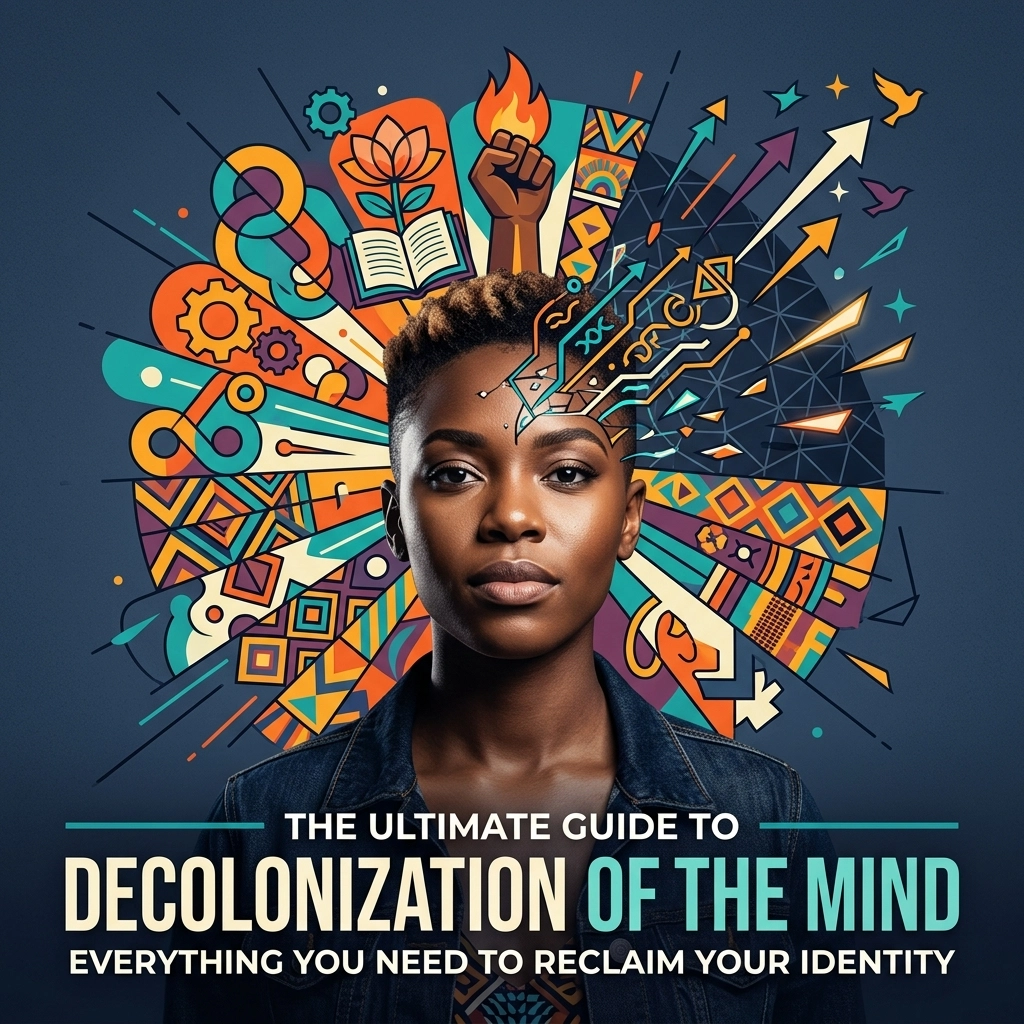
Category: Decolonization of the Mind
This guide explores the profound journey of dismantling internalized colonial structures and reclaiming an authentic sense of self. By examining the intersections of history, psychology, and the power of narrative, we provide a roadmap for mental liberation and the restoration of cultural identity.
Whose voice do you hear when you are alone with your thoughts?
Is it the voice of your ancestors, or is it the lingering echo of a system designed to make you forget them?
We live in a world where the maps are drawn by the victors and the histories are written in the ink of the powerful.
But the most dangerous borders are not the ones on a map.
The most dangerous borders are the ones inside your head.
To reclaim your identity, you must first acknowledge that your mind has been mapped by someone else.
The Ghost in the Machine
We often talk about colonization as a historical event, a series of dates and treaties found in dusty textbooks.
We speak of the physical occupation of land and the extraction of resources.
But the most enduring legacy of empire is not the wealth it stole, but the way it taught the stolen to view themselves.
Decolonization of the mind is the process of unlearning the hierarchy of humanity that was forced upon us.
It is the realization that your "common sense" might actually be a set of inherited prejudices.
It is the recognition that your standard of beauty, your definition of success, and even your concept of God may have been imported.
In my book, Alike Regardless: This Is Where It Began, I explore the fundamental truth that humanity began as one, yet we have been conditioned to see only the fractures.
The courage to look past these fractures is the first step toward mental sovereignty.

The Language of the Subconscious
Language is more than a tool for communication; it is a carrier of culture.
When a colonial language is forced upon a people, it carries with it a specific worldview, a specific logic, and a specific set of values.
As Ngũgĩ wa Thiong'o famously wrote in Decolonising the Mind: The Politics of Language in African Literature: "Language, any language, has a dual character: it is both a means of communication and a carrier of culture."
He argues that to control a people’s language is to control their tools of self-definition.
When we speak, are we expressing our soul, or are we translating ourselves into a format that is acceptable to the dominant culture?
The fracture begins here.
We are taught to see our native tongues as "dialects" and our indigenous knowledge as "superstition."
We are taught to value the abstract logic of the West over the rhythmic, lived experience of our own heritage.
This is not a failure of intelligence; it is a triumph of conditioning.
To decolonize the mind is to sanctify your own language and your own ways of knowing.
It is the act of refusing to be a translation of someone else’s original.
The Haitian Mirror
Haitian history offers us a visceral example of this struggle.
In 1804, Haiti became the first nation to successfully overthrow colonial rule and abolish slavery.
It was a physical decolonization of the highest order.
Yet, the world did not celebrate this liberation; it punished it.
The mental battle continued long after the French were driven out.
The systemic isolation of Haiti was an attempt to prove that the colonized could not survive without the colonizer’s mind.
We see this today in the way history is taught: or rather, the way it is omitted.
If you do not know where you came from, you will accept whatever identity is assigned to you.
Identity is not a gift given by the state; it is a memory reclaimed from the fire.

The Neuroplasticity of Liberation
The mind is not a static object; it is a living, changing landscape.
Science tells us about neuroplasticity: the brain’s ability to reorganize itself by forming new neural connections.
This means that the "colonized mind" is not a life sentence.
It is a habit.
Unlearning is more difficult than learning.
Learning is the addition of new information; unlearning is the surgical removal of internalized lies.
It requires us to scrutinize our knee-jerk reactions.
Why do we feel "unprofessional" when we wear our hair naturally?
Why do we feel "uneducated" when we use the slang of our neighborhoods?
These are the symptoms of a mind that is still under occupation.
The process of decolonization requires a "quiet urgency": a steady, controlled dismantling of the structures that tell us we are less than.
It is not about frantic energy or outward performance.
It is about the internal landscape.
It is about the privacy of the soul.
The Illusion of "The Other"
The colonial project relied on the creation of "The Other."
It required a hierarchy where some were closer to the "ideal" than others.
In Alike Regardless: This Is Where It Began, I challenge this entire framework.
If we accept the colonial premise of "The Other," we have already lost.
We must return to the source: the shared biological and spiritual origin of all people.
Not to ignore our differences, but to strip away the value judgments attached to them.
Not to process pain, but to endure it until it transforms into power.
We must develop what I call cognitive literacy: the ability to read the world without the lenses provided by our oppressors.

Practical Steps Toward Mental Sovereignty
How do we begin this reclamation?
First, we must audit our influences.
Who are the authors on your shelf? Who are the voices in your ears?
If your entire intellectual diet is produced by the same systems that colonized your ancestors, your mind will remain a colony.
Second, we must embrace the discomfort of "unbelonging."
When you begin to decolonize your mind, you may find that you no longer fit into the social structures you once navigated with ease.
This is not a loss; it is an evolution.
Third, we must reconnect with our ancestry, legacy, and memory.
This is not a nostalgic exercise.
It is a strategic retrieval of the tools we need to build a future.
Finally, we must recognize that this is a lifelong practice.
Decolonization of the mind is not a destination you reach; it is a way of walking through the world.
The Future of the Mind
As we look toward the future, the theme of Decolonization of the Mind will become even more central to our global conversation.
It is the necessary precursor to any real social change.
You cannot build a new world with an old mind.
You cannot find freedom using the logic of the cage.
The work is internal.
The work is visceral.
The work is yours to do.
Reclaiming your identity is not about finding something new; it is about remembering something ancient.
It is about stripping away the layers of "civilization" to find the human underneath.
It is the courage to be "Alike Regardless" of the labels meant to divide us.
The revolution will not be televised, but it will be thought.
It will be felt in the way you breathe, the way you speak, and the way you refuse to bow.
The borders are open.
The map is blank.
Start drawing.
Get your copy of Alike Regardless: This Is Where It Began today and begin the journey back to our shared human origin.